|
Digital Photographers' Newsletter
MARCH 2013 Edition
This month's summary
(items are now hot linked from summary for convenience) |
The eyes will improve your portraits.
Nothing will give you more of the personality of your subject as much as do the eyes. If you want to take portraits that truly stand out, you need to give the eyes as much emphasis as possible.
There are a few ways you may emphasise the eyes.
- You can focus on them,
- use colour contrast to draw attention to them and,
- zoom in to get closer to them.
Each of these techniques has its own pros and cons. It all depends on the subject you are photographing and the theme you’re trying to express in your image. What do the eyes convey in a close up image with the subject looking directly into your camera? They will convey the raw emotional power of the eyes.
Even though your subject is not physically present, just seeing the eyes this close makes you feel what they feel. Human beings are very perceptive when it comes to reading eyes. In less than a second, we can know how someone feels. As a photographer, it really helps to use this to your advantage when taking portraits. The eyes are everything.
Focus on the eyes: If you are close enough focus on the eyes consider using manual focus to help you make sure the eyes are really the focus of your image. This precise focus will draw out your subject’s emotions. The more you can see in the eyes, the more the eyes have to say.
Automatic focus is quite acceptable if you are far away and using a telephoto lens. There is a slight error that happens when you use automatic focus on the eyes, but it is dramatically reduced. This one reason why professional photographers often use moderate telephoto lenses (70mm to 150mm) when taking portraits. Spot focussing also helps when focussed on the eyes with telephoto lenses.
Create colour contrast near the eyes: When you create colour contrast near the eyes, it naturally draws you viewer to the eyes, emphasizing them even more (cf eye makeup). There a lot of ways to achieve this effect. You can place some colourful makeup near the eyes, place some jewellery near them, or use a colourful head scarf, hat, or wrap.
When blue eyes are surrounded by a complimentary colour (say orange), they appear even more blue. The brighter the colours near the eyes, the brighter the eyes will look in the final photo.
Place the eye in one of the four thirds of the frame: We use the rule of thirds for composition all the time. Why not use it to emphasize the eyes and draw more attention to them? You do not have to always zoom in real close to achieve this effect.
Try zooming out a little more to get the entire face while keeping the eyes in one of the four thirds regions. Make sure you give your subject a space to look into if they are not looking at your camera.. This makes the photo feel much less cramped, and it gives the impression that something has caught your subject’s interest.
The eyes can communicate emotion in ways that nothing else can. When you use this to your advantage while taking portraits, your photography will truly strike at the heart.
Where Is Your Camera In Relation To Your Subject’s Eyes? Where your subject looks in a photo says a lot. If your subject is staring directly at the camera, most viewing your image will take it less seriously. To communicate sincerity in an image, you need to pay attention to your camera’s location in relation to your subject’s eyes.
Is the camera pointed slightly away? Are you looking down on your subject? Is your subject looking up at you? Each of these seemingly slight variations of camera position can have a big impact on the overall message you’re sending to your viewer.
Keep the eyes in the image when you photograph someone: The eyes really are the windows into the soul. Photos of the back of peoples’ heads are about as interesting as photos of empty furniture. This is one you should really pay attention to in sports photography. People oftentimes think it’s enough to “take a shot of the action,” but the action is not just a bunch of random bodies playing a sport. The “action” takes place in the eyes.
Sometimes having the eyes just barely in the shot can make for some great art. It communicates a kind subtlety that leaves a lot to the imagination. Try framing the shot so your subject’s eyes are in the upper corner. If you manage to fire off a shot of your subject looking back at you, there’s a good chance you can get one of these elusive yet awesome photos.

If you want serious images, you will have to get serious.
There is a reason models are so valuable in the industry. They know how to get serious when the time comes. In essence, they know where to look. The photographer must also know where to point the camera and compose the images.
Some of the best candid photography is shot from the hip. Try bringing the camera down to hip level, pointing it up, and taking a few shots that way (auto focussing is an asset here). If you zoom in a little bit, it won’t look like your subject is staring down at you. The point is to take yourself out of your subject’s line of sight. If it is very clear that your subject cannot see you, the photo will carry a sense of intimacy.
Either way, you have to get serious if you want to communicate seriousness in your images. Try bringing your camera to your side, lift it up, or bring it down lower. Do anything different from the normal snapshot point and shoot and you stand a far better chance of making an impact with your images.
What certain camera positions communicate: Want to make someone look small? Just get on top of a chair and take a photograph looking down. This happens all the time when people photograph teir children. They do not think to get down to their child’s level, and it usually kills the personality of the image. It makes your children look like another small and powerless individual rather than emphasise their wonderful personalities.
If you have children, try photographing them from their eye level. The best way to do this is with a zoom lens so you can get a candid shot. If your children know you’ are photographing them, it kills the mood. Yes, you will be doing a lot of crawling around on the carpet or grass, but the effect is much more powerful than the top-down images your friends are probably taking.
When you bring the camera below the eye-level of your subjects, you create the reverse effect. Now they are looking down on you, and it makes them look positively gigantic. This effect is often used when photographing pro athletes and politicians. It adds to their domineering character as they are perpetually looking down on you.
As you can see, it’s not just important to pay attention to where you subject is looking. It is just as important to pay attention to where you are.
- are you in the line of sight
- does it look like you are running into an acquaintance on the street, or
- are you happening upon a private moment?
How you position the camera says a lot about the moment you are capturing. Use it for the right effect.
The importance of communicating with your subject.
Most photographers will create their worst imagery when they feel under pressure: Is your subject comfortable with what you are doing doing. Do they feel you are ‘professional’ and know what you are doing. Will their portrait image reflect their expectations? By keeping the lines of communication open they will be more at ease.
Shape the Feeling: Aside from making everyone feel more comfortable and natural, you can use your words to shape the feeling of a photograph. When you talk with your subjects, try to paint a mental picture for them. If they are not smiling, say things to boost their confidence. Merely mentioning someone’s name in conjunction with some kind of success makes them act that way. Your images will be the proof.
For any number of emotions you want to create, there is something you can say to bring those emotions out. Loneliness, excitement, anger, love, apathy, and the list goes on. When you communicate with your subjects, tell stories involving each of these emotions. Tte stories do not have to be real. Movies are not “real” either, but someone inevitably leaves the theatre feeling good from the experience. The same should hold for your subjects when their session is over.
Subjects To Avoid: Do not give too many instructions or your subject will feel uncomfortable. When you are not comfortable, they will not be comfortable, and thus the downward spiral begins. Do not discuss religion or politics or denegrate others.
You will need to give your subjects some kind of instruction. However once you are positioning their arms and foreheads, you will lost any sense of natural emotion and feeling. Ideally, your photography should allow your subjects to reveal who they truly are. You should not be using it to try and mould your subjects into something you want them to be. There is a big distinction between the two.
Talk to your subjects as you would a friend, and try to capture them when they are least expecting. That is when the real emotion comes out. If you finish the session on a high you can expect some wonderful images.
|
FREE -Photography BASIC NOTES
If you would like a FREE copy of my Basic notes please email request with Subject "Basic Notes".
See details
|
LATEST TIPs & FACT SHEETS for Digital Photographers gives you advice on How to Use your Digital Camera. Gives you a kick-start to using your camera. These are shared FREE to our email Lifetime Network members.
Available TIPs:
TDP-0006
Flower Photography (in progress).
TIP-0005
How to use your digital camera.
TIP-0004
Photographing motor sports.
TIP-0003
Capturing movement with shutter speed.
TIP-0002
Commonsense colour management.
TIP-0001
Relationship of shutter speed and aperture.
Available FACT Sheets:
FS-1202
Downloading images from digital cameras.
FS-1201
Reduce image file size and modify image before sending as email attachment.
If you would like a copy of any of these TIPs or Factsheets or to receive my regular updates please send me an email and I will place your contact on my email network group.
Samples of TIPS can be found in previous Newsletters (see left column this Newsletter)
Brisbane Seminars in the Library
Our popular monthly Seminars on BASIC digital photography are held on the third Thursday of every month at the Everton Park Library, BRISBANE
from 6-7.45pm.
The next seminar will be held on the
21st MARCH
Monthly Seminars include discussions on digital photography, Digital Photography TIPs, and general discussion. ALL welcome
These Seminars are FREE and are part of my studio community program with the BCC Everton Park Library.
Bookings are essential
Please call the Everton Park Library on
07 3403 7400
to reserve your place.
|
Local Photographers' Email Network
You can be a member of my email network and receive these Newsletters each month and get regular advice of library seminars and discussion groups.
Contact me to get your name on the list (FREE) and receive my regular TIPs For Digital Photographers.
Community Group Workshops
The next Group Workshop will be held in April (further details to follow)
If you would like to attend or organise/ lead a future Group Workshop please contact me.
Workshop & Seminar page |
Restoration of
Family & Historical Photographs
Please contact me for further details.
If you prefer please send me a scan of your image for a free no obligation quotation. All services are covered by my guarantee of total satisfaction.
No restoration is too large. too difficult or too small.
You may view my price list here. Restoration tme beyond the basic prices is charged by the quarter hour.
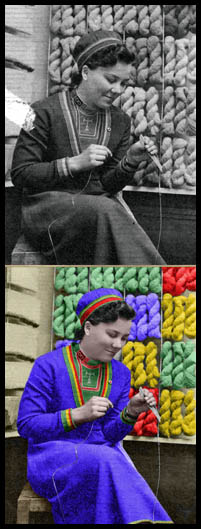
Special considerations for Seniors Card holders and any flood damaged photographs.
You may view other examples of Photo Restoration on my Restoration pages
|