What photo equipment to take on your photo trip?.
With the following tips, you can keep your camera equipment safe and get the most out of your digital photography while traveling with a minimum of equipment.
Bring only what you truly need: When you’re traveling abroad, and you are putting yourself into a fairly vulnerable position and it just does not make sense to carry all that expensive gear with you all the time. If you don’t need that big digital SLR and long telephoto lenses to get the image, go with a smaller and lighter point-and-shoot. For most travel photography, that will be all you need.
Think about what you will be doing all day long and whether you really want to carry heavy camera and gear with you. Generally you will find heavy camera equipment to be more of a liability than an asset.
When you are traveling to less economically developed areas, your camera equipment is like a target to potential would-be thieves. It really is best to keep your camera concealed in a backpack while you are walking around. Only take your camera out to get the image, and then put it back. It may be more work, but it is the safest option.
Pack your bags and pack more than one bag: Not only should you carry less camera equipment, you should pack a large bag and a small bag for the actual photo shoots. The large bag will carry and organize all of your lenses and camera equipment while the smaller one protects equipment from the elements during your various photo trips on location. Both should be weather resistant and padded. More information on camera bags can be found in my August 2012 newsletter.
Pack a travel tripod: Travel tripods are getting better every year. They are extremely light and compact. Most can be folded up to fit into your photo shoot bag.. Alternatively, you can use a ‘chain pod’ which is a length of chain that you attach to your camera and wrap the other end around your foot. By holding the chain taught, you help steady the camera. And the chain folds up a lot smaller than a tripod. Large travel tripods are more nuisance than enough for the amount of use you will give them. Further information on miniature tripods in my October 2011 newsletter.
At the airport: Camera gear is fragile. You should never place it in any bags you plan on checking for the cargo hold. The people who load the luggage onto the plane will throw it around, and there’s a good chance the lens glass or any of the other parts will get damaged. This is yet another reason to only bring what you need. Carry all of your lenses and camera bodies with you on the plane. Check your airline for restrictions regarding the size of your carry-on luggage, and always comply – it will save you a lot of hassles.
When you are using digital cameras there is nothing to worry about with airport scanners (unlike film cameras). Don’t worry about magnets on the conveyor belts accidentally wiping your memory cards – there is no evidence to support these concerns.
Be mindful of condensation: When traveling, there is a good chance you will be going from one climate to another. When the temperature outside is very different from the temperature indoors, you need to protect your camera from condensation that can form on the outside and inside of the camera body. The best solution is to place your camera in a ziplock bag whenever you are not actively shooting. The condensation will collect on the outside of the bag instead of your camera, keeping your camera dry.
Check and double check: On the night before you leave, you should have everything layed out and accounted for before packing. I find it useful to make up a list for checking before leaving and repacking in transit. Pack for the duration of the trip. That includes lens wipes, cleaning solution, filters, memory cards, batteries, and all of the other basic things. Odds are you will not be able to readily purchase it when you need it later.
Summary: Keep your gear light, have fun, and hide the expensive stuff from prying eyes. Whatever you do, avoid being the typical tourist with the flashy camera and kit hanging around your neck. That is a sure fire way to lose what you have worked so hard to get.

Images from recent Community Group Photo Workshop.

A panorama view of "Redcliffe Jetty" by David Collings.
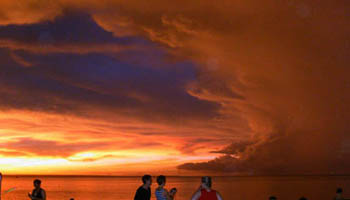
"Gathering storm at dusk' by Lorrie Christie.
How to send images back to your family and friends while on your trip?
Generally we do not go on holiday trips to spend more time with computers. Naturally, there is a problem when you want to share the pictures you have taken.
With no computer in sight, how do you email them to your family and friends?:
Unfortunately you are going to have to use a computer of some sort if you want to share any of the images you have taken, unless of course, you are taking all of your images with a smartphone. Then you are simply carrying your computer in your pocket.
There are ways to access your email, but you have to go through a totally different and often confusing thing called a webmail client. It’s basically the same thing as email but it lives in your browser window. It works, but it will require some learning.
Facebook + Flickr = easy solution:
These days there is a strong chance most of your family is on Facebook. For smaller pictures where you do not care too much about quality, Facebook is much better than email. You simply upload the photos to your Facebook, click “share,” and everyone in your family can see them.
There is only one problem with the strict Facebook approach. If you want to show off your skills as a photographer, it’s somewhat lacking. Facebook automatically resizes your photos down to something smaller and faster to download. This will reduce the image quality quality.
If you wish to retain image quality then use Flickr in conjunction with Facebook: Flickr is very much the Facebook of photo sharing. It’s an online community of photography enthusiasts who appreciate quality photography. None of the photos you upload to Flickr are resized down to take up less space.
To share a photo from Flickr with your family, just copy the link to the photo and paste it on your Facebook wall. When you do this, Facebook realizes that it is a link to your photo and provides a little preview with a description. If you want someone to download your photo, just send them a message through Facebook and have them download it.
The best part of all of this is you do not need your own computer to do it! You can do everything from the guest computer lounge at your hotel or from a friend’s computer.
If you still need to use email: Consider getting a second email account that is easy to access from the web. Some obvious candidates are Gmail, or Hotmail. They have a web-based email program you can use from any computer all over the world. You still have to be careful about the size of the pictures you send. If they are too big, the email server will reject them. This is another area where Facebook + Flickr shine above all other alternatives
The world is gradually moving away from email anyway and in the medium future internet communication will be done using social networking sites like Facebook and Flickr.