|
Digital Photographers' Newsletter
February 2012 Edition
This months summary
- Using Fill-flash in daylight images.
- Recent website added to environmental photography links page giving you world coverage of images linked to google maps for location identification.
- TIP for Digital Photographers " How to Use your new digital Camera" - now available by email request
- Library Seminar 6pm-7.45pm Thursday 16 February
Using Fill-flash in Daylight Images
Although it may seem strange to others who are not photographers, one of the best uses of your flash is during bright sunlight!
A flash helps to eliminate dark shadows (for instance under the eyes and chin of faces) on your subject. Fewer shadows means your subject has more detail overall. Although your eye can see your subject's smile when the sun is behind them, your camera cannot. The flash will fill-in your subject's face so the camera can see the smile also.
This image was taken without a flash:

The following image shows how much brighter the image is with fill-in flash.

This does not just apply to taking pictures of your friends. Anything you photograph will look better when it does not have strong shadows.
Professional wedding photographers use flashes when taking images of weddings whether in doors or outdoors, even in midday sunlight. The flash fill-in outside removes the shadows and darker shadows around the eyes and lifts the facial features. You can apply the same techniques for all your images and get images with much more impact in regard to exposure and brightness.
Most modern day compact and digital Single Lens Reflex (DSLR) cameras will fill-flash automatically. However you, as the photographer, need to be warry in using it.
Be aware when using fill-flash in daylight: The brighter the sunlight from behind your subject, the stronger flash you’ll need to light up the shadows.
That’s because your camera automatically picks a faster shutter speed to avoid turning the entire photo white (also known as overexposure). Fill-flash mode is for moderate backlighting, and other settings help to compensate for other light imbalances.
For intense backlighting you will need to use different regions of yor image to set the exposure meter to get best 'balance' of the fill-flash. Experience is a valuable tool here - experiment with your camera settings, particularly where you measure the image exposure.
For soft lighting subjects you can alternatively use a light diffuser: Flash is a direct and bright light that shines on your subject for a split second. Consider using a diffuser in these circumstances.
What is a flash diffuser? It’s anything you place in front of your flash to spread out the light and make it less intense or use to soften the natural light. Clouds are a natural diffuser for sunlight. Diffused light is shadowless.
You can use any transparent white membrane such as white sheets or other material, either between the natural light source or in front of flash light.
Tip: If you have an external flash (separate flash which is off your camera) you are able to bounce it off a reflective surface. This is another way of diffusing the flash, and it’s a favorite among professional photographers. The light that comes back from the bounce is even more diffuse than from using a sheet of cotton or some other fabric as a diffuser between your subject and the light source (natural or flash).
Florencio Martin has developed a website showing a collection of photos of every city in the world, pictures of landscapes and most beautiful monuments all over the world with its people and customs. The best photos taken by tourists on their travels.
An amazing collection of photographs which will interest all photographers and particularly travel photographers.
Photographers familiar with the SE Queensland region will be taken by the colouring and lighting in this image of the Scarborough cliffs.
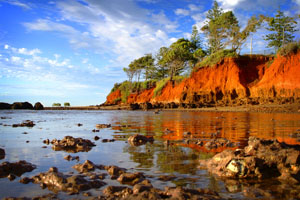
photo by prophoto 2008
|
FREE
Photography BASIC NOTES
If you would like a FREE copy of my Basic notes please email request with Subject "Basic Notes"
email 
LATEST TIPs for Digital Photographers gives you advice on How to Use your Digital Camera. Gives you a kick-start to using your camera. This has been shared FREE to our Network members.
If you would like to receive my regular TIPs please send me an email and I will place your contact on my email network.
email
Brisbane Seminars in the Library
Our popular monthly Seminars on BASIC digital photography are held on the third Thursday of every month at the Everton Park Library, BRISBANE
rom 6-7.45pm.
FEBRUARY seminar will be THURSDAY 16th
This month's Seminar will include discussions on digital photography, TIPSD, and general discussion. ALL welcome
These Seminars are FREE and are part of our studio community program with the BCC Everton Park Library.
Bookings are essential
Please call the Everton Park Library on
07 3403 7400
to reserve your place.
Local Photographers' Email Network
Are you currently a member of our email network receiving these Newsletters each month and advice of library seminars and discussion groups?
Contact me to get your name on the list (FREE) and receive my regular TIPs For Digital Photographers. Samples of TIPS can be found in past Newsletters (see left column this Newsletter)
email
Lifetime Saturday or Sunday Workshops
Our workshops are offered to assist you to learn the basics of digital photography by practical use of your camera.
By gaining a better understanding you will become more competent and creative. You will marvel at the improvement of your images and be encouraged by your newfound skills.
Next workshop on portraiture and people photography will be held in MAY.
Please register your interest Don't miss out on having your say to have your favourite subject presented.
email
workshop page here
|